
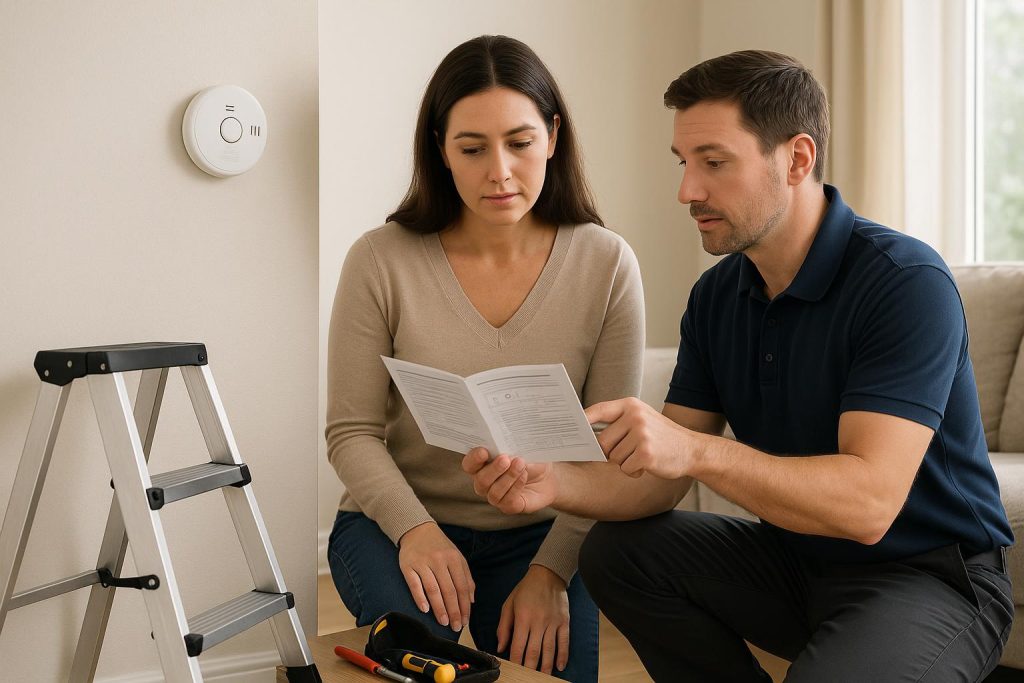
Carbon monoxide (CO) detectors can often be installed high on a wall or on the ceiling, but the correct mounting height depends on the manufacturer’s instructions and the type of detector. Unlike smoke, carbon monoxide mixes with indoor air and does not consistently collect near the floor or ceiling.
For many residential carbon monoxide alarms, wall or ceiling mounting is permitted. However, there is no universal mounting height that applies to every CO detector.
In commercial buildings, detector placement may also depend on the approved fire alarm design, building occupancy, ventilation systems, and applicable fire safety requirements.
What Is the Correct Carbon Monoxide Detector Mounting Height?
The correct carbon monoxide detector mounting height is the height approved by the device manufacturer.
Some manufacturers permit installation on the ceiling or high on a wall. Others specify particular distances from the ceiling, floor, or nearby equipment.
A commonly repeated recommendation is to mount a carbon monoxide detector approximately five feet above the floor. However, five feet is not a universal installation requirement and should not replace the instructions for your specific device.
Before mounting a CO detector, confirm:
- Whether the device is approved for wall or ceiling installation.
- The manufacturer’s minimum clearances.
- The required distance from fuel-burning appliances.
- Any restrictions involving windows, vents, or airflow.
- Whether the detector is designed for residential or commercial use.
Following the manufacturer’s instructions is more important than choosing an arbitrary installation height.
Should Carbon Monoxide Detectors Be High or Low?
Carbon monoxide detectors do not generally need to be installed close to the floor.
Carbon monoxide has a molecular weight similar to air and typically mixes with the surrounding indoor air through normal air movement.
This means carbon monoxide does not behave like a heavy gas that consistently settles near the ground.
Similarly, it does not rise and accumulate near the ceiling in the same way that smoke often does.
For many CO-only alarms, either wall or ceiling installation can be appropriate when permitted by the manufacturer.
The best position is one that allows the device to sample representative room air without interference from ventilation, obstructions, or nearby appliances.
Can Carbon Monoxide Detectors Be Mounted on the Ceiling?
Yes, many carbon monoxide detectors can be mounted on the ceiling if the manufacturer permits ceiling installation.
Ceiling-mounted CO alarms can provide effective detection when installed in suitable locations.
However, not every device is approved for ceiling mounting.
Some models are designed specifically for wall installation or have different clearance requirements.
When installing a carbon monoxide detector on the ceiling:
- Confirm that ceiling mounting is permitted.
- Follow the manufacturer’s distance requirements for walls and corners.
- Avoid locations directly affected by supply-air vents or fans.
- Ensure the device remains accessible for testing and maintenance.
Combination smoke and carbon monoxide alarms may have different installation requirements because the smoke-sensing component is designed to detect smoke that rises toward the ceiling.
Does Carbon Monoxide Rise to the Ceiling?
Carbon monoxide does not consistently rise to the ceiling or sink to the floor under normal indoor conditions.
Because its density is similar to that of air, carbon monoxide generally mixes throughout an indoor space.
Air movement, ventilation, temperature differences, and the location of the CO source can affect how the gas spreads.
This is why carbon monoxide detector placement should not be based solely on whether the gas is heavier or lighter than air.
A properly selected detector should be installed in a location approved by its manufacturer and suitable for the space being protected.
Where Is the Best Place to Mount a Carbon Monoxide Detector?
The best place to mount a carbon monoxide detector depends on the building, potential CO sources, and the device’s intended use.
In homes and residential units, carbon monoxide alarms are commonly installed near sleeping areas so occupants can hear an alarm during the night.
Depending on applicable requirements and the building layout, additional alarms may be needed on other storeys or in other designated locations.
For commercial properties, placement may depend on the occupancy and the equipment or activities that could produce carbon monoxide.
Potential considerations include:
- Sleeping areas: Install residential alarms where occupants can hear them, following applicable requirements.
- Fuel-burning equipment: Follow the manufacturer’s instructions for placement relative to furnaces, boilers, fireplaces, and other combustion appliances.
- Commercial kitchens: Evaluate the equipment and ventilation arrangements when determining whether CO detection is needed.
- Mechanical rooms: Use detectors suited to the environment and any applicable system design requirements.
- Enclosed parking facilities: Where CO monitoring is required, use equipment designed for the intended gas detection and ventilation control application.
A detector designed for a bedroom may not be suitable for an industrial facility, mechanical room, or parkade.
Where Should You Avoid Installing Carbon Monoxide Detectors?
Poor placement can interfere with detection or contribute to nuisance alarms.
Unless the manufacturer specifically permits the location, avoid installing carbon monoxide detectors:
- Directly beside windows, doors, or ventilation outlets.
- Behind curtains, furniture, or other obstructions.
- Inside cupboards or enclosed spaces.
- Immediately above or beside fuel-burning appliances.
- In areas exposed to excessive humidity, steam, grease, or dust.
- Near chemicals or vapours that could affect the sensor.
- In locations outside the device’s approved temperature range.
Do not assume that a standard household carbon monoxide alarm is suitable for installation inside an attached garage.
Vehicle exhaust, temperature fluctuations, and environmental contaminants can affect equipment performance. Garage monitoring applications may require specialized detection systems.
What Is the Difference Between Carbon Monoxide and Carbon Dioxide Detectors?
Carbon monoxide (CO) and carbon dioxide (CO₂) are different gases, and their detectors serve different purposes.
Carbon monoxide detectors identify dangerous concentrations of carbon monoxide, a colourless, odourless gas produced by incomplete combustion.
Carbon dioxide detectors measure CO₂ concentrations, often for indoor air quality monitoring, ventilation control, or specialized safety applications.
A carbon monoxide alarm cannot be used as a substitute for a carbon dioxide detector, and vice versa.
Where Should a Carbon Dioxide Detector Be Mounted?
Carbon dioxide detector mounting height depends on the purpose of the sensor, the room’s airflow, and the manufacturer’s specifications.
For indoor air quality monitoring, CO₂ sensors are often positioned in the occupied breathing zone, away from direct ventilation airflow.
However, industrial CO₂ detection systems may have different installation requirements, particularly where compressed or refrigerated carbon dioxide is stored or used.
Do not apply residential carbon monoxide alarm mounting instructions to a commercial CO₂ monitoring system.
What Is the Difference Between Smoke Detector and Carbon Monoxide Detector Placement?
Smoke detectors and carbon monoxide detectors respond to different hazards.
Smoke often rises with heated air during the early stages of a fire. For this reason, smoke alarms are commonly installed on ceilings or high on walls according to applicable installation requirements.
Carbon monoxide mixes more readily with indoor air, allowing many CO-only alarms to be installed on either walls or ceilings.
Combination smoke and CO alarms must satisfy the installation requirements for both sensing functions.
Always follow the manufacturer’s instructions for the exact model.
Are Carbon Monoxide Detector Requirements Different in Commercial Buildings?
Commercial carbon monoxide detection requirements depend on the building’s occupancy, design, installed equipment, and applicable codes.
Some commercial CO detectors are connected to a building’s fire alarm or life safety system.
Others are part of specialized gas monitoring or ventilation control systems.
These applications may have different requirements for:
- Detector mounting height and location.
- Sensor type and operating range.
- Wiring and power supplies.
- Alarm notification and monitoring.
- Testing and calibration.
- Maintenance and replacement.
In a commercial building, detector placement should follow the approved system design and applicable equipment standards.
Property managers should not relocate or replace system-connected detectors without confirming that the changes maintain the required protection.
Advanced Fire Protection provides commercial fire alarm services for businesses and institutional facilities.
How Do You Install a Carbon Monoxide Detector?
Before installing a carbon monoxide detector, review the manufacturer’s instructions and confirm that the device is suitable for the location.
A typical installation process includes:
- Select the correct detector. Choose equipment approved for the intended residential or commercial application.
- Confirm the mounting location. Check the permitted height, orientation, and clearances.
- Avoid unsuitable conditions. Keep the device away from obstructions, excessive moisture, and interfering airflow.
- Install the detector securely. Follow the manufacturer’s mounting and electrical instructions.
- Test the alarm. Use the recommended test procedure to confirm that the device operates.
- Maintain the equipment. Test it as directed and replace the detector at the end of its rated service life.
Commercial installations may require additional design review, wiring, commissioning, or coordination with a qualified technician.
How Often Should Carbon Monoxide Detectors Be Tested?
Carbon monoxide detectors should be tested and maintained according to the manufacturer’s instructions and applicable requirements.
Many residential alarms have a built-in test button that checks certain alarm functions.
However, pressing the test button does not necessarily verify the accuracy or sensitivity of the CO sensor itself.
Commercial gas detection systems may require additional inspections, functional testing, calibration, or sensor replacement.
If a detector displays a trouble condition, fails a test, or reaches its marked end-of-life date, arrange appropriate service or replacement.
Frequently Asked Questions About Carbon Monoxide Detector Placement
How High Should a Carbon Monoxide Detector Be Mounted?
There is no universal mounting height for every carbon monoxide detector. Many models permit wall or ceiling installation, but the manufacturer’s instructions determine the correct mounting height and clearances.
Is It Better to Install a Carbon Monoxide Detector High or Low?
Neither position is universally better. Carbon monoxide generally mixes with indoor air, so the best mounting location depends on the detector’s design and installation instructions.
Can You Put a Carbon Monoxide Detector on the Ceiling?
Yes, if the detector is approved for ceiling installation. Follow the manufacturer’s instructions for placement and required clearances.
Should Carbon Monoxide Detectors Be Installed Near the Floor?
Not necessarily. Carbon monoxide does not consistently settle near the floor. Low mounting may be appropriate for certain devices, but it is not a universal requirement.
How Far Should a Carbon Monoxide Detector Be From a Furnace?
The required distance depends on the detector manufacturer and the installation environment. Follow the product instructions and avoid installing the device where normal appliance operation or airflow could interfere with detection.
Where Should a CO₂ Detector Be Installed?
For indoor air quality applications, CO₂ sensors are often installed in the occupied breathing zone. Industrial CO₂ detection systems may require different locations based on the hazard, ventilation, and approved design.
Can a Carbon Monoxide Detector Detect Carbon Dioxide?
No. Carbon monoxide and carbon dioxide are different gases. A CO alarm does not measure CO₂ concentrations.
What Should You Do if a Carbon Monoxide Alarm Goes Off?
Treat a carbon monoxide alarm as a potential emergency. Move occupants to fresh air, call emergency services from a safe location, and do not re-enter until responders confirm it is safe. Seek urgent medical attention if anyone has symptoms of CO exposure.
Commercial Carbon Monoxide Detection in Edmonton
Carbon monoxide detector placement is an important consideration for buildings with fuel-burning equipment, enclosed parking facilities, and other potential sources of combustion gases.
For commercial properties, selecting suitable equipment and following the approved detection system design are essential.
Advanced Fire Protection supports businesses and property managers in Edmonton and surrounding Alberta communities with fire alarm system inspections, installation, testing, and maintenance.
If you need assistance reviewing a commercial fire alarm or detection system, contact Advanced Fire Protection to discuss your property’s requirements.
